
Isn't being interrupted the problem?
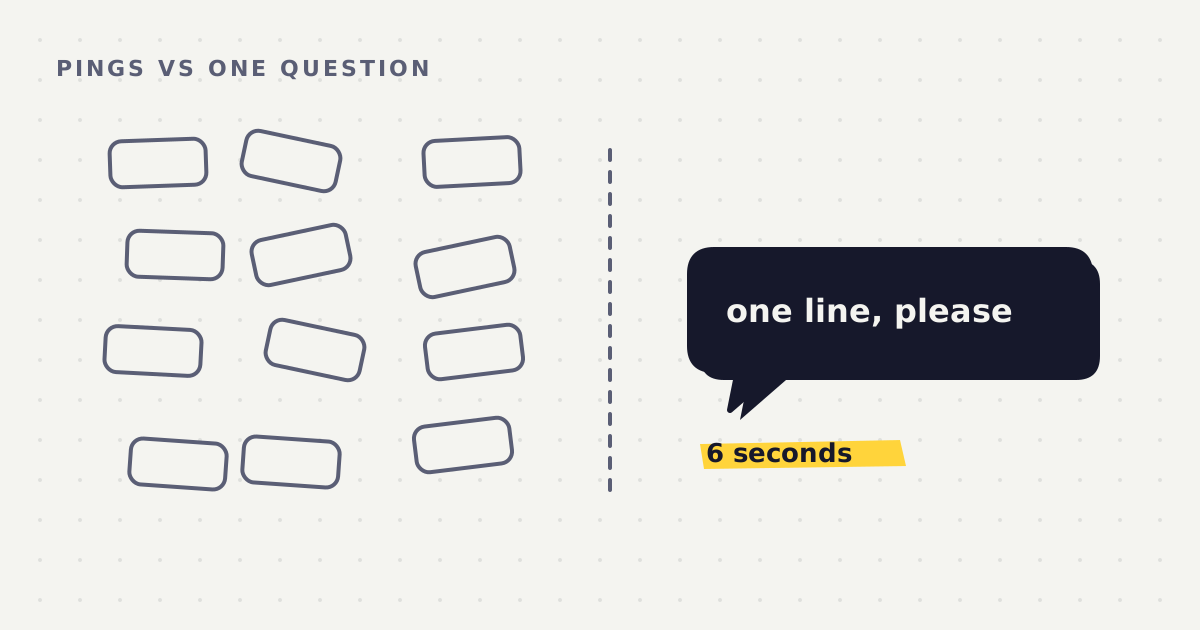
If you build something on your own, focus is the scarcest thing you have. There's no team to pick up the slack, and the two good hours you get in a day are the ones the product depends on.
So here's a fair objection to Whatcha Doing, and founders tend to raise it first. The app's whole job is to interrupt you. Isn't being interrupted the problem?
It's worth taking seriously, because the research on interruptions is not kind.
What interruptions actually cost
In 2008, Gloria Mark, Daniela Gudith and Ulrich Klocke gave 48 people a stack of emails to answer. Some worked undisturbed. Others were interrupted by phone or instant message roughly every two minutes.
The surprise was that the interrupted groups finished faster: about 20 minutes, against nearly 23 for the undisturbed group. They paid for it. Compared with the undisturbed group, the interrupted people reported significantly more stress, frustration, time pressure and effort. They got through the work by rushing, and they felt it.
So yes, a steady stream of interruptions makes work worse. The question is whether one question every ninety minutes belongs in that category.
Not all interruptions are the same
Look at what the study's interruptions were: other people, arriving every couple of minutes, each carrying a new task to deal with. That's what a busy inbox or a team chat feels like.
A check-in from Whatcha Doing differs on each count:
- You choose how often. Ninety minutes is the suggested start, which works out to a handful of questions in a working day, not dozens.
- It carries no new work. It asks one thing, about something you've already done. You type a line and the dialog closes. It takes about six seconds.
- It can wait. Deep Work mode holds the questions until you surface from a long stretch, so it never lands in the middle of the work you most want to protect.
The interruption you didn't notice
There's also a comparison the objection leaves out. The alternative to a scheduled question is rarely an unbroken afternoon. It's the message you check without deciding to, the tab that opens on its own, the "quick look" at something that turns into forty minutes. Those don't feel like interruptions because you started them.
A question at a fixed interval is the one interruption that tells you about all the others. If the honest answer at 3 pm is "read news for most of it", you now know something no amount of uninterrupted time would have told you.
One planned question costs six seconds. The unplanned ones cost the afternoon.
If it still feels like too much, the fix is the setting, not the idea. Start with a long interval and shorten it only if your answers get vague.
Sources
- Mark, G., Gudith, D., & Klocke, U. (2008). The cost of interrupted work: More speed and stress. Proceedings of the SIGCHI Conference on Human Factors in Computing Systems (CHI '08), 107–110.
Try one planned question instead of a hundred unplanned ones. The first week is free.
Download free