
Where did the afternoon go?
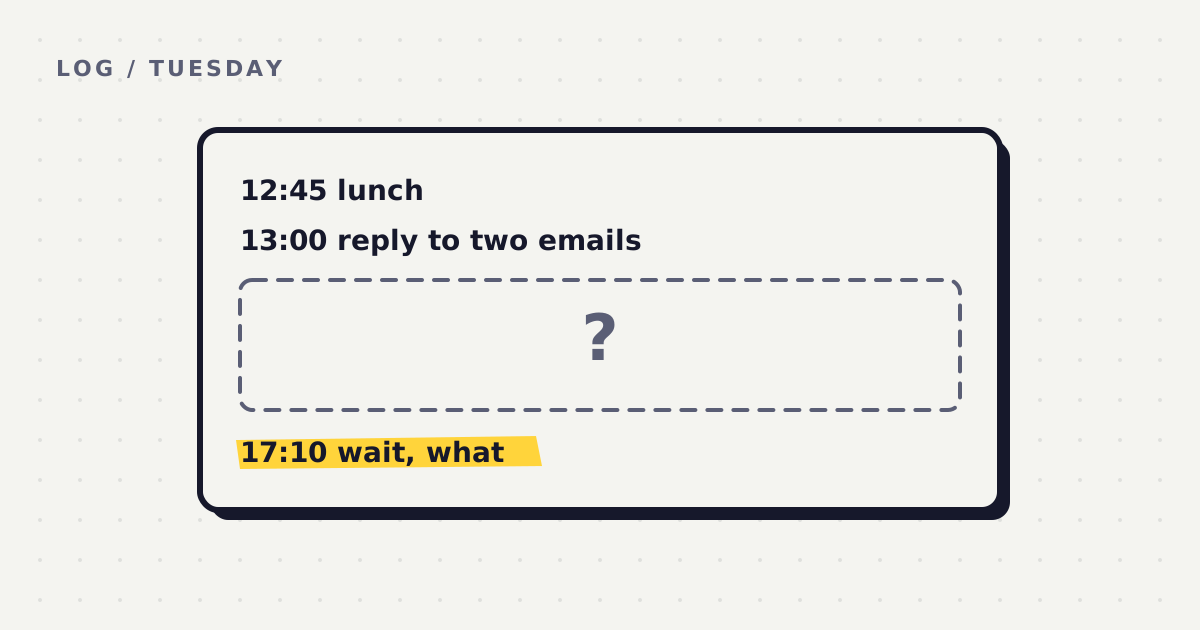
You sit down after lunch to answer two emails. You look up and it's ten past five. The emails are answered. So, apparently, is the afternoon.
Some people call this time blindness. Whatever you call it, it isn't a character flaw and it isn't rare. It's how time perception behaves when your attention is busy, and there's good research on why.
A busy mind stops counting
Psychologists separate two kinds of time judgement. A prospective one is made while you're keeping track: you know you'll be asked how long something took. A retrospective one is made afterwards, from memory.
In a 2010 meta-analysis, Richard Block, Peter Hancock and Dan Zakay pooled the experiments on how mental effort changes both. While people are working hard, time judged in the moment shrinks. Attention spent on the task isn't spent on the clock, so less time seems to pass. Looking back, the effect reverses: busy stretches, especially broken-up ones, are remembered as longer.
That's the afternoon. While you're in it, it moves fast. Afterwards it feels long and full, so you remember it as a solid block of work. Neither feeling is a measurement.
Your mind is elsewhere about half the time
In 2010, Matthew Killingsworth and Daniel Gilbert used a phone app to interrupt 2,250 adults at random moments and ask what they were doing and what they were thinking about. People's minds were wandering in 46.9% of the samples.
Their method matters as much as the number. Researchers interrupt people and ask in the moment because memory is a poor witness. Ask someone at 6 pm what they did all afternoon and you get a story. Ask them at 2:40 and you get what actually happened.
Don't watch the clock. Get asked.
The usual fixes are timers and alarms. They tell you that time has passed. They don't tell you what happened in it, and after the third one you stop hearing them.
What works is borrowing the researchers' method:
- Get interrupted at an interval. Something outside your head that breaks in, because the part of you that would remember to check is the part that's busy.
- Answer in one line, right then. "Answered two emails, then read the thread they linked to for an hour." That line is worth more than any end-of-day summary.
- Read the lines back once a week. One afternoon looks like bad luck. Four of them in a row look like a pattern you can do something about.
That's what Whatcha Doing does. It interrupts you with a pop, asks "what did you do in the last hour and a half?", and saves your answer to a text file on your own computer. On Sunday it compares the week with the goals you set on Monday. If you'd rather not be lectured, set the report to Gentle: same findings, same score out of 10, a calmer delivery.
Start with a long interval. Ninety minutes is a good first setting, and you can tighten it later.
Sources
- Block, R. A., Hancock, P. A., & Zakay, D. (2010). How cognitive load affects duration judgments: A meta-analytic review. Acta Psychologica, 134(3), 330–343.
- Killingsworth, M. A., & Gilbert, D. T. (2010). A wandering mind is an unhappy mind. Science, 330(6006), 932.
Find out where your afternoons actually go. The first week is free.
Download free