
Your thesis will take longer than your worst-case guess
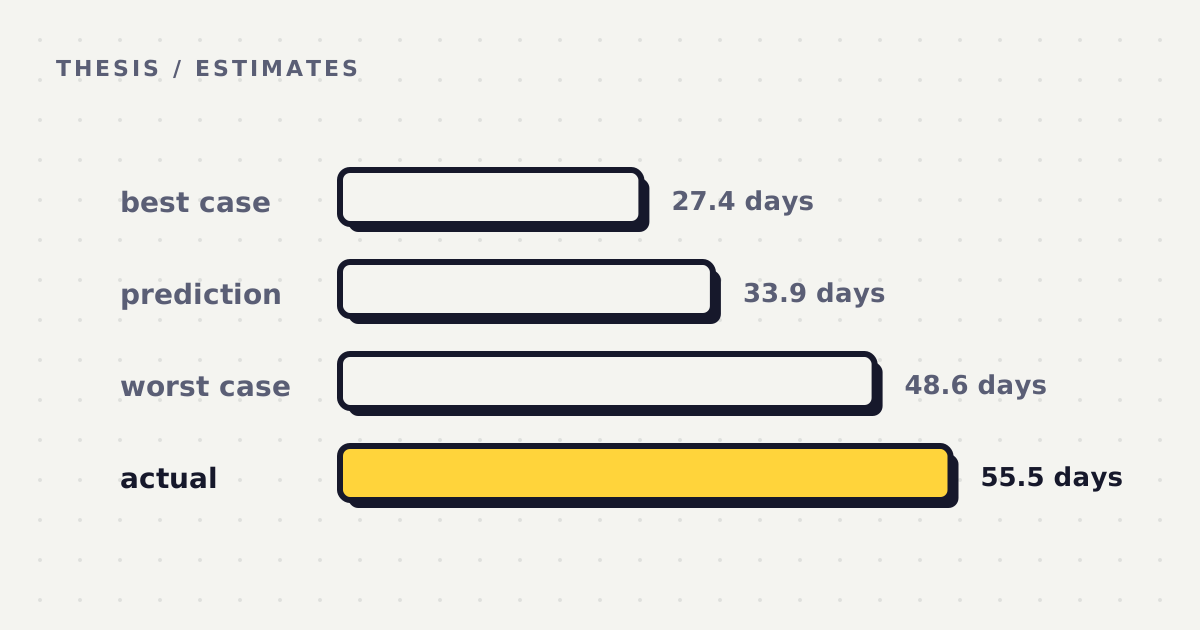
In 1994, the psychologists Roger Buehler, Dale Griffin and Michael Ross asked 37 students a simple question: when will you finish your thesis?
On average they said 33.9 days. Asked for a version where everything went as badly as it reasonably could, they said 48.6 days. The real average was 55.5 days. Only about 30% finished by the time they had predicted. The typical student missed their realistic estimate and their pessimistic one.
This is the planning fallacy, and it's one of the most reliably reproduced findings about how people think about time. Knowing about it doesn't make you immune. The students in that study were psychology students.
Why a far-off deadline makes it worse
In the same research, people predicted by imagining how this particular task would go from here, and rarely asked how long similar tasks had taken them before. A thesis is the perfect trap: one enormous task, a deadline months away, and no previous thesis of your own to compare with.
A distant deadline also puts no pressure on any single day. Missing Tuesday costs nothing you can feel. Neither does missing the next one. The cost is real, it's just saved up and delivered all at once in the last six weeks.
"Write every day" isn't the answer you were sold
The standard advice is to write every day. Much of it traces back to Robert Boice's studies of academic writers in the 1980s and 90s. When Helen Sword went back to the original papers, she found that the famous study had nine people in each group, that many participants had dropped out because charting their writing was a nuisance, and that some figures quoted in popular books don't appear in the article at all.
Her own survey of more than a thousand academics found that only a small minority actually write every weekday. Productive writers work in very different rhythms. What they share is that they protect time for writing and notice quickly when it isn't happening.
The rhythm is yours to choose. Noticing when it stops is not optional.
What actually helps
- Plan from your own record, not your hopes. Forecasters call this the outside view: estimate from how long similar work actually took. Write down what each writing session produced. After two or three weeks, you have a record of your own pace to plan from.
- Turn the deadline into weekly objectives. "Finish the methods chapter" by March is invisible in October. "Draft the sampling section" this week is something you either did or didn't.
- Check every week, not at the end. A 2016 meta-analysis of 138 experiments found that monitoring progress makes people more likely to reach their goals, especially when the progress is written down.
Whatcha Doing is built around that weekly loop. On Monday you write the month's goal and this week's objectives. During the week it interrupts you and asks what you just did, and you answer in one line. On Sunday you get a written report on whether the week moved the thesis or just felt busy, with a score out of 10 and one change for next week. The first week is free, and students get 40% off Lifetime on request.
Sources
- Buehler, R., Griffin, D., & Ross, M. (1994). Exploring the "planning fallacy": Why people underestimate their task completion times. Journal of Personality and Social Psychology, 67(3), 366–381.
- Sword, H. (2016). "Write every day!": a mantra dismantled. International Journal for Academic Development, 21(4).
- Harkin, B., Webb, T. L., et al. (2016). Does monitoring goal progress promote goal attainment? A meta-analysis of the experimental evidence. Psychological Bulletin, 142(2).
Turn a far-off deadline into a weekly check. The first week is free.
Download free