
Fifteen minutes of looking back
If you're writing a thesis or building a product alone, the advice you get is almost always about doing more: more hours, more focus, more systems. One of the more interesting studies of the last decade found a gain in the opposite direction. People did better after they stopped working and spent the time thinking about the work.
The study
In 2014, Giada Di Stefano, Francesca Gino, Gary Pisano and Bradley Staats ran a field experiment with new employees at Wipro, a large Indian IT services company, during their technical training. One group spent the last 15 minutes of each training day writing about what they had learned and which strategies had worked. They did this for ten days. A control group simply kept working for those 15 minutes.
On the final assessment, the people who reflected scored about 15 points higher on a 100-point test. That's an improvement of roughly 23% over the average score, from giving up a slice of working time.
The same paper reports lab experiments that point in the same direction, and suggests why it works: reflecting made people more confident that they could do the task, and that confidence carried into how they performed.
Two honest caveats. It was published as a working paper, and the field setting was training, where learning is the whole point. Still, the direction of the result is hard to ignore.
Thinking needs something to think about
Reflection only helps if it has material. "How did this week go?" with nothing in front of you produces a mood, not a lesson. The Wipro trainees were reflecting on that same day, while the details were still fresh.
For a week, the details are what slip first. By Sunday, Tuesday is a blur. That's why a record made at the time matters: it gives the reflection something concrete to work on.
A week you can't remember is a week you can't learn from.
How to spend your fifteen minutes
- Read the week, not your memory of it. Start from what you actually logged, line by line.
- Name the pattern. Not "I was distracted". Something specific: "every afternoon I was in a meeting, the main task didn't move."
- Write one change for next week. One. A list of seven resolutions is just a new way of not changing anything.
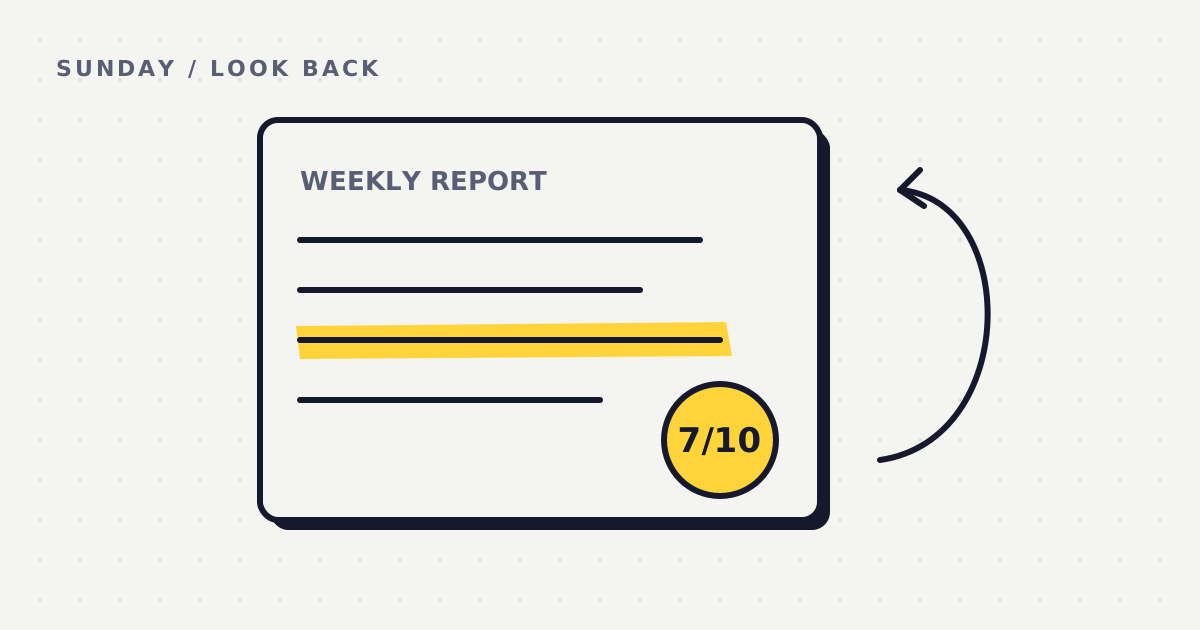
Whatcha Doing's Sunday report is built to start those fifteen minutes for you. It sets what you said you'd do beside what you did, names the pattern, gives a score out of 10 and ends with one instruction for next week. Your part is to read it and decide whether you agree. If you're working toward a far-off deadline like a thesis, this is the habit that keeps it from sneaking up on you.
Sources
- Di Stefano, G., Gino, F., Pisano, G. P., & Staats, B. R. (2014). Learning by thinking: How reflection aids performance. Harvard Business School Working Paper 14-093.
Let Sunday's report start your fifteen minutes. The first one is free.
Download free