
What Whatcha Doing actually is
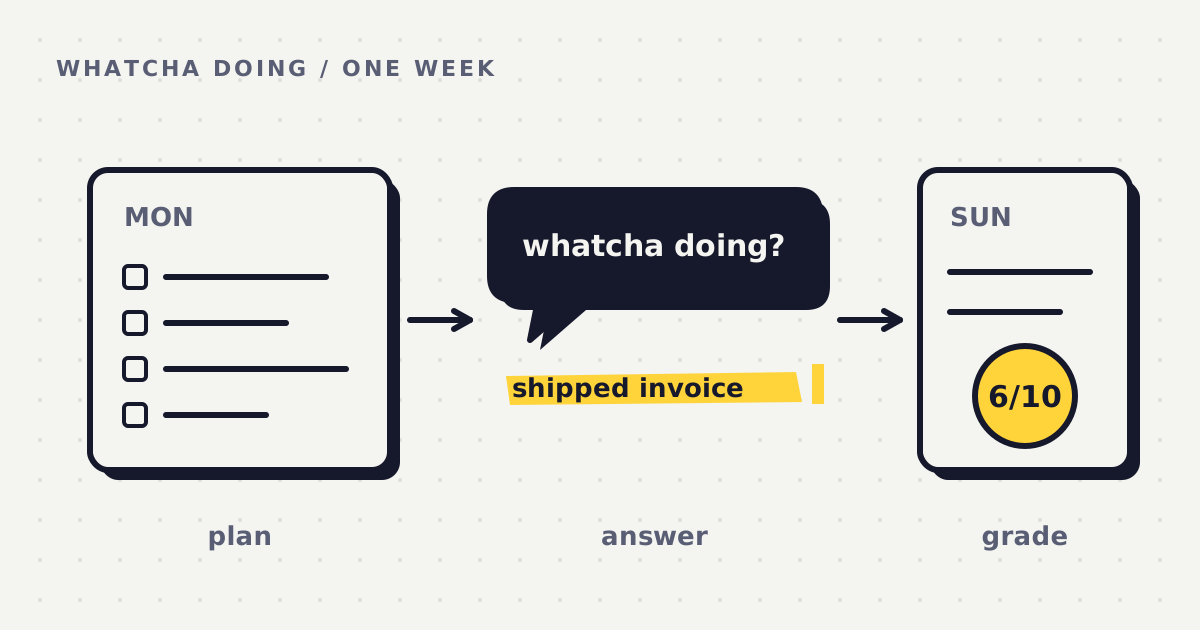
The short version. Whatcha Doing is a desktop app for Windows, macOS and Linux. Every so often it makes a small pop and asks what you just did. You type one line. On Monday you write down what the week is for. On Sunday it reads the week back against that plan and tells you, with a score out of 10, whether you kept your word.
That's it. Everything else is detail, and the detail is below.
Who it's for
It's built for people with nobody checking on their day. You work for yourself, or you build something of your own after work. You're writing a thesis, studying for an exam that's months away, or changing careers. Or the afternoon just keeps disappearing on you and you'd like to know where it went.
What those people share is a gap. They have goals, and they have hours, and nobody ever sets the two side by side. Whatcha Doing does that one job.
A week with it
Monday, about four minutes. You open the planner and write your goals for the month, your objectives for the week and today's tasks. These are the only standard the app grades you against. It has no opinion of its own about what counts as productive.
All week, about six seconds at a time. At the interval you choose, a small window pops up and asks what you did since the last time it asked. You type one line and it goes away. Ninety minutes is a good starting interval. When you need a long stretch without interruptions, Deep Work mode holds the questions until you're back.
10:30 AM – 11:15 AM (45m): Email, then YouTube.
Sunday. Your log and your plan go to an AI coach, which writes the week up. What you said you'd do. What you actually did. Where the time leaked. How much was deep work and how much was distraction. The pattern that explains the gap, one instruction for next week, and a score from 1 to 10.
You choose how it talks to you. Gentle, Honest or Brutal. The findings and the score are the same in all three. Only the delivery changes.
What it isn't
- It isn't a tracker that watches you. It doesn't record your screen or log which apps were open. It asks instead of watching, which is also how it knows about the work you did away from the screen.
- It isn't for managers. There are no teams, no dashboards and no way to point it at someone else. It's one person holding themselves to their own plan.
- It isn't a cloud service. There's no account. Your log, your plan and your reports are plain text files on your own computer, and you can open them without the app.
Why it works this way
Three findings shaped the design.
A 2016 meta-analysis of 138 experiments found that monitoring progress toward a goal makes people more likely to reach it, and that the effect is bigger when the progress is physically written down. That's why there's a log at all.
Research on self-monitoring shows that recording a behaviour at the time it happens changes the behaviour, more than reconstructing it later does. That's why it asks during the day rather than once in the evening.
And a field study of new employees found that people who spent 15 minutes reflecting on the day's work did better on a final test than people who spent those minutes working. That's why there's a Sunday report: reflection needs something concrete to reflect on.
Other tools tell you where your time went. This one tells you whether you kept your word.
What it costs
- Free trial, 7 days. Everything, including your first weekly report, with no card and no AI key. After that, pick a plan to keep going.
- Monthly, $5 a month or $48 a year. A report every Sunday, all three tones, written on my server so you never need a key. Cancel any time.
- Lifetime, $65 once. The same, forever, with reports written on your own AI key. Every future update included.
On the trial week and on Monthly, your week passes through my server to the AI model and none of it is stored. On Lifetime it goes from your computer straight to Anthropic, DeepSeek, Google Gemini or Perplexity on your own key. Setting one up takes a few minutes, and a report costs a few cents, billed to you by the provider. Every plan has a 14 day money back guarantee.
The fastest way to know whether it's for you is to run one week. Plan on Monday, answer the pop, and read what Sunday says.
Sources
- Harkin, B., Webb, T. L., et al. (2016). Does monitoring goal progress promote goal attainment? A meta-analysis of the experimental evidence. Psychological Bulletin, 142(2).
- Korotitsch, W. J., & Nelson-Gray, R. O. (1999). An overview of self-monitoring research in assessment and treatment. Psychological Assessment, 11(4), 415–425.
- Di Stefano, G., Gino, F., Pisano, G. P., & Staats, B. R. (2014). Learning by thinking: How reflection aids performance. Harvard Business School Working Paper 14-093.
Run one week. The first week is free.
Download free